
"coffee per capita China"
100 article(s) found

Coffee statistics collate how many cups of coffee are consumed per capita in China?
Table 1-annual per capita coffee consumption cups in China (2012-2004) year 2012 2011 2010 2009 2008 2007 2006 2005 per capita consumption cups 6.9 5.1 3.7 4.0 3.8 3.3 2.8 2.6 Coffee imports (million bags) 1088 809 573 618 592 535 505 425 397 population (10,000) 135404 134735 13409

The increase of national income is expected to increase the per capita consumption of coffee.
The improvement of China's national income level is expected to lead to the increase of coffee consumption per capita. The market penetration of the young and middle-aged population helps to drive the growth of potential coffee consumers. As a drink with unique taste, coffee is very popular among young and middle-aged people. The survey shows that different age groups in China have different degrees of love for coffee, among which people aged 41-50 account for 24% of the total.

Is China, the country that drinks the most coffee per capita in the world, shortlisted?
Walking around the streets of the United States, you will immediately feel that the United States is a country immersed in coffee: a Starbucks can be found on almost every street corner; McDonald's is turning into McCoffee; Duncan doughnuts are also becoming the most frequented place for breakfast. As you all know, these world's largest coffee chains all originated in the United States, so the United States has become the largest in the world.

The per capita annual coffee consumption in China is less than 6 cups. Understand the development of coffee drinking habits in Europe, America, Japan and South Korea.
Professional coffee knowledge exchange more coffee bean information please follow the coffee workshop (Wechat official account cafe_style)
The Development Prospect of Coffee in China ranking of per capita Coffee consumption in Beijing, Guangzhou and Shenzhen
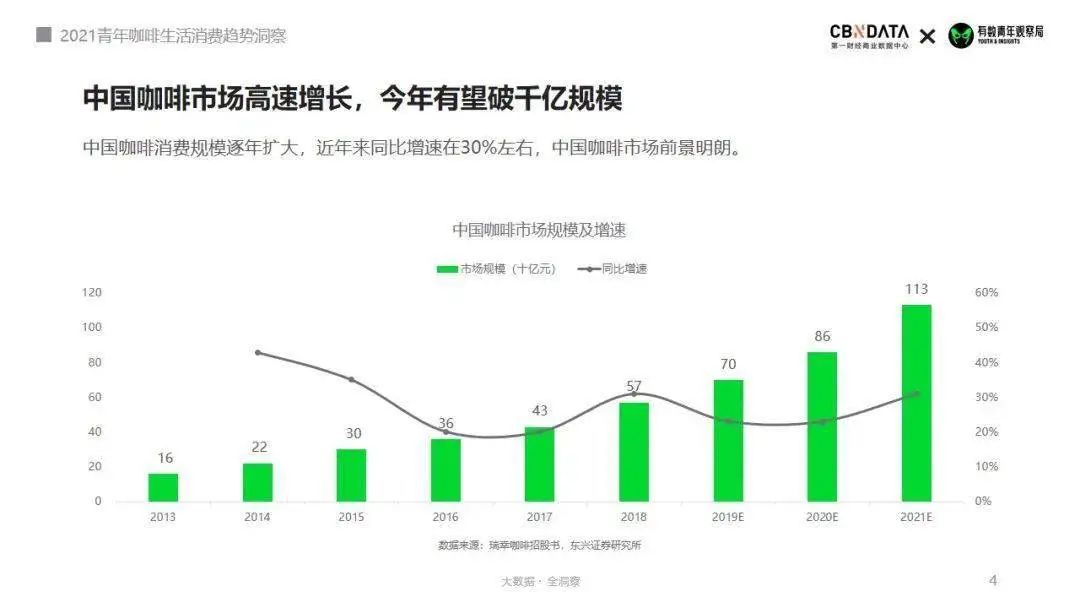
China's coffee market is in a stage of rapid development, and the consumption trend in recent years also confirms this. In addition, with the expansion of the coffee market, capital pays more and more attention to coffee brands, with the blessing of various factors, the coffee track is becoming more and more crowded. On May 28th, the first Financial and Economic data Center (CBNData) jointly with the Youth Observatory released a copy of "2021 Youth Coffee"

The coffee consumption market has great potential.
Following Kaiping (official Wechat account vdailycom) found that Beautiful Cafe opened a small shop of its own, and the three-day Fifth China International Coffee Exhibition ended at the China International Exhibition Center in Beijing. The reporter learned from the exhibition site that China's coffee consumption market has great potential and is mainly concentrated in the north, Shanghai, Guangzhou, Shenzhen and second-tier provincial capitals, but the coffee industry is still lacking.

China's coffee consumption market has great potential, and the coffee industry should not be underestimated.
Recently, the three-day Fifth China International Coffee Exhibition came to an end at the China International Exhibition Center in Beijing. The reporter learned from the exhibition site that China's coffee consumption market has great potential and is mainly concentrated in the north, Shanghai, Guangzhou, Shenzhen and second-tier provincial capitals, but the coffee industry still lacks unified standards and professionalism, which restricts the development of China's coffee industry to a certain extent. Jin Kuiding (Heaven

Foreign media: the amount of coffee per capita in China is less, but the Chinese coffee market has great potential.
Communication of professional baristas Please pay attention to Coffee Workshop (Wechat official account cafe_style) Coffee started relatively late in China. In the early days, only high consumers or returnees were interested in going to the cafe for a drink, but with the passage of time, the domestic coffee market has undergone earth-shaking changes. As an important part of the world coffee market, China has attracted much attention from foreign media.

Analysis of China Coffee Consumption Market in 2015
1. Changes in coffee drinking volume and drinking structure in China: compound 13% growth, instant-ready to drink-fresh grinding From 1998 to 2012, coffee consumption in China increased from 199,000 bags to 1.1 million bags, with an annual growth rate of about 12.8%. China has a population of about 1.3 billion, and coffee consumption has risen from 9.6 grams to 47.6 grams, with an average annual growth rate of about 12.1%. If the growth rate of 12.8% is maintained, the deadline

Coffee consumption Culture-Why Starbucks can sell at high prices in China
The article holds that an important issue is culture. Since China opened its economy to the outside world and imported products from abroad in the late 1970s, these imports have gained some preference from image-conscious consumers. Wang Fei, a consultant in Washington, grew up in Wuhan. Traditionally, foreign products are thought to be better in workmanship, more tasteful and better, he said. People's society

Coffee consumption in North Korea far exceeds that in China
According to the latest report from the International Coffee Organization, North Korea imported an average of 19000 bags (60 kg / bag) of coffee per year from 2000 to 2012, equivalent to 50 grams of coffee beans and about 7 cups of coffee per capita, Yonhap news agency reported. From 1990 to 1999, North Korea imported an average of less than 1000 bags of coffee a year, but that number increased significantly after 2000, the report said. It is reported that

At present, the per capita annual coffee consumption in China is 5 cups-the Chinese coffee market is entering a white-hot stage.
Starbucks, which claimed to be a coffee e-commerce platform several years ago, repeatedly delayed its launch plan and finally decided to focus its online business on membership services. On December 15, 2014, to the surprise of the coffee chain, carving time (hereinafter referred to as Diaoguang), a local coffee chain that had been in operation for 17 years, had built one in just six months.

The latest ranking | drinking coffee, the United States is not even in the top 20!
When drinking coffee, the United States did not even make the top 20 and did not see China at all; when drinking tea, China only ranked 19th! Question 1: what do we drink the most? Question 2: how much room for the development of these two industries? A few days ago, the London Coffee Festival (London Coffee Festival) has officially opened, coffee lovers from all over the UK and around the world gathered together

The new market mode of the coexistence of "street coffee" and "business coffee" opens the coffee consumption market.
Professional baristas Please follow the coffee workshop (official Wechat account cafe_style) with the economic development, the consumption pattern of our country is in the stage of upgrading. Beverage consumption has changed from functional to enjoyable, and consumers have begun to pay attention to consumer taste, which brings huge market opportunities for coffee consumption. According to statistics, the annual per capita coffee sales in Europe and the United States is 500 cups.
Nestle wants to set up Coffee Center in China
China's coffee market has great room for development. In recent years, both the coffee consumer population and the consumer market in China have shown a trend of rapid growth, with its annual per capita consumption increasing at a rate of 30%, far exceeding the annual growth rate of world coffee consumption. It is estimated that by 2020, China will become a major coffee consumer in the world equivalent to Japan. Therefore, for the major coffee brands to enter the Chinese market hugely

Mobile Coffee entering China aims at Multi-level Consumer Market
Recently, Wheelys Coffee, a smart mobile coffee car brand born in Sweden and incubated in Silicon Valley, has released a customized version of Wheelys coffee car for the Chinese market. At the same time, Wheelys Coffee announced the launch of national market expansion, and the establishment of an industrial fund to support the development of urban operators to accelerate the layout in China. Wheelys Coffee, which uses mobile coffee carts to make and sell coffee, was founded in 2014

You can't drink coffee with milk? Basic knowledge of coffee
According to the data, the current market size of coffee in China is about 70 billion yuan, with an annual growth rate of more than 15%. Experts predict that domestic coffee consumption will reach 300 billion yuan in 2020. At present, the per capita annual coffee consumption in China is 5 cups, which is far lower than the average of about 300 cups per capita in Japan and South Korea, and also far lower than the world average of about 240 cups. Therefore, China is becoming the world.

Coffee consumption in China is estimated to increase by 20% a year.
For the exchange of professional baristas, please follow the coffee workshop (Wechat official account cafe_style). Although China's annual per capita coffee consumption is still far from that of advanced countries. However, in China's coastal cities and other areas, coffee is being accepted by a large number of young people, and even loved by the middle class. Experts even predict that the total coffee consumption in China will grow at an average annual rate of 20% in the future.

A brief Analysis of the reasons for the low Coffee consumption in China
Coffee has become the world's largest natural drink, but why it is very difficult to open up the market in China. Is it because Chinese people are used to drinking tea? The rent is too high? The consumption of coffee is too low, which is caused by many factors. First of all, because the price of coffee is too high, the popularity of coffee in Europe and the United States has developed from the grassroots. Today, there are 7 billion people around the world.

There is an opportunity for China's ready-to-drink coffee market to meet the hundreds of billions of mark in innovative packaging.
With the continuous improvement of the quality of public life and the continuous change of the concept of life, ready-to-drink coffee with gradual progress in production technology and product quality is heating up rapidly, and a large number of young people and business people are the potential groups behind it. According to statistics, the per capita consumption of coffee in Western Europe is 5.4 kg, while that in Singapore and Japan is 1.9 kg and 1.4 kg respectively.